Determinism was a progressive belief, approximately during Newton's time, that rationalized the world with respect to the physical world. As classical mechanics was gradually unfolding it was becoming more and more apparent that there were invariable universal laws that governed physical bodies. Thus, based upon a few initial parameters, one could determine the projected motion of a moving body. This seemed to suggest that physical bodies were not orchestrated in any way, but rather determined ever since the beginning of time. If this were true, this also meant that our actions were determined since space-time began.
Determinism brought crisis to the order of society. It meant that we were no longer liable for our actions, and also suggested that our fate has already been determined. For the religious, the saved are already saved and the damned are already damned. For the non-religious personnel, our actions could no longer be accounted for.
This problem prompted Descartes to establish human consciousness outside the physical world such that it would not be subject to the laws of physics and no longer bound by determinism. By establishing consciousness outside the physical world, order would be restored once again and the power to change the course of our actions is back into our rightful hands.
However, what logic did Descartes use to establish consciousness outside the human brain into some transcendent realm? His logic is as follows:
1. One's whole essence is to think - to be conscious. (Famous lines: I think therefore I am.
2. It is not the whole essence of anything physical to think
3. Thus, one who is the conscious being is not physical.
There is a secondary argument to this. In order to accept premise 2, we must defend it as follows:
2a Anything physical has to be characterized by shape, size, and spacial location
2b Thinking is not characterized as such
Though this argument to a degree seems valid, Descartes would not hold this argument if he accepted the conservation of momentum (or energy for that matter). We now know that the conservation of momentum is an undeniable and fundamental law of physics. How could our consciousness, a non-physical entity, influence the course of various neurotransmitters/electrical impulses in our brain such that we have a conscious experience in the physical world? This would mean our conscious mind would have to change the momentum of various particles without conserving it - such is a gross violation of science, thus rendering this argument invalid.
Now here's where it gets interesting (or maybe less so if you hate physics). I thought upon this issue and tried to doctor this argument. Think for a moment that you have two detachable bodies. If they were to spontaneously split and go their separate ways, momentum would be conserved, and consciousness could be attributed to this spontaneity. However, such did not make sense in terms of the conservation of energy. Then I reconciled that the internal energy (heat of the object) could be converted into kinetic energy and thus both laws of conservation would be satisfied. Again, however, this violated the 2nd law of thermodynamics, where spontaneous processes are irreversible.
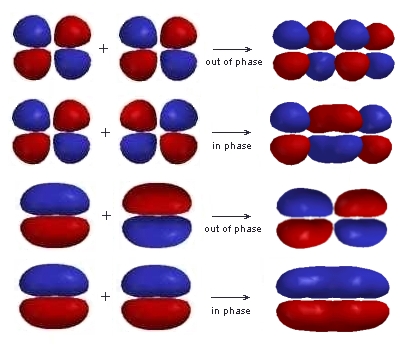
My last attempt was to go down to the quantum level. Here, we cannot be so certain of the behaviors of quantum sized particles. Also, quantum particles are not subject to the same classical laws of physics. In fact, uncertainty is the very nature of this field as we describe parameters in terms of probabilities. In such a physical body, strange things happen as we no longer consider a trajectory corresponding, but rather probability maps. Take for example this following molecular orbitals:
Notice how there are empty spaces in each orbital. Supposedly these electrons jump across the empty space without ever going through the space. Apparently the probability of ever finding an electron in that space is ZERO. I digress.
Upon thinking about this subject matter, I came to reason maybe it is these very uncertainties that our consciousness takes charge of. It is not that our consciousness violates any law of physics, but rather it acts through them. By dictating where the electrons should be (through an infinite number of possibilities) perhaps our consciousness dictates the physical world through some sort of collective butterfly effects. I am reasoning very thinly here, with not much empirical evidence, but maybe this theory is not as crazy as it seems. After all, Einstein held the belief that "God does not play dice." On a deeper level, maybe he was insinuating a higher power taking charge in orchestrating chance and variability.
http://rxdebt.blogspot.com/
I think they're hard and haven't read the answers so please think about it with me:
Brain Teaser #1: The King and His Coins (Difficulty Level: Easy)
Brain Teaser #2: The Oldest Child (Difficulty Level: Difficult)
Two men that haven’t seen each other in many year ran into each other in the street. The first man says to the second that it’s great to see him after so many years and asks weather he has a family or not. The second man replies that he does have a family and that it consists of a wife and three children. The first man then inquires about the ages of the three children. The second man answers this question in the form of a riddle. He says that the product of his three children’s ages is equal to 36 and that the sum of the their three ages is equal to the number of the blue house on the corner of the road. Further, all of the ages are exact unit numbers and no fractional equivalents should be used. The first man walks up to the blue house on the corner, looks at the number, and returns to the second man. The first man then states that the second did not give him enough information to solve the riddle. The second man replies that the first man is correct and that one additional clue is needed to solve the riddle. The second man smiles and says that his oldest child’s eyes are blue. The candidates task is to tell you the ages of the three children and correctly identify the number on the house.
The typos are not mine...they were like this in the packet lol.
I've been taking an intro to philosophy course, so I admittedly I'm a complete knoob when it comes this stuff. However, we've been learning about Socrates's quest for defining what justice is. For Socrates, the truth was out there but it is something that could not be found. With that said, it is better to know that you do not know rather than to be ignorant that you do not know.
In the Republic, Plato tries to define what justice is and how a just society should operate. However, to me, his society and so called justice system sucks.
Thus, we come to Thrasymachus's argument that:
Justice is nothing more than the advantage of the stronger.
Granted Socrates refutes this definition, Thrasymachus still raises an interesting point. There is no such thing as universal justice, and so we cannot define it.
My question to you guys is, is there such thing as a universal justice that we can define? If so, what is it?
In my dream I had a great idea. Since in my physical chemistry class we were studying thermodynamics, I had dreamt of taking an endothermic reaction that would proceed spontaneously and creating a instant cold pack. So I was hired by some chemical company to find out which reactions were endothermic while proceeding spontaneously.
When I woke up, I immediately started to think of any such reactions, but only to my disappointment, I realized they already have instant cold packs...
I'm so tired of getting parking tickets. And those ticket enforcement guys...Let's get rid of them!
So for this scholarship I'm applying for there is an essay question asking that we discuss what we feel will be the most important advancement in engineering in the next 25 years. The essay will be judged on whether they agree, your insight into the subject, and the understanding of the widespread application of ideas.
So, thus far I have compiled a few ideas as to what I think may happen in the next 25 years:
Near room-temperature superconductors
Memristors
Devices making clean water available worldwide
Fusion Reactors
Genetically modified retroviruses as treatment for all sorts of diseases
Ditto for Bacteria
Something making MRIs cheaper (not sure what it would be)
This would be a good topic to start discussing. If any of the other Eng. Students would like to know about the scholarship just speak up and I'll post the link.
I don't know about anybody else, but I always thought English was just showing you could make complex sentences with "appropriate" words. Essentially, you write about nothing (at most answer a simple question) and make it like a piece of art as much (as a high-schooler is able to do). I always got good grades in high-school english, but coming to college, I saw my grades tank to "average" (which is actually below the inflated B-average we see now in most classes). Why? The truth was revealed to me by an amazing English prof that I have this quarter. Turns out you need to say something in your paper!
According to him, it's like making a case...but something that is non-trivial. So, you state something that is debatable and make as strong a case (using stuff i dunno like structure...) as possible. Apparently, he says that high-schools and colleges stress different things. One is deep-reading of a novel and the other would be simply churning out a paper that sounds ok. Who knew...I now feel more confident about my paper haha...
Hey Girls,
I have this awesome idea. I figured it wouldn't really appeal to guys very much because we don't care much for our hair - though this might have been applicable to Wei back in the day.
So basically I've thought of a brush that you use for your hair, but in the handle you can pour Shampoo or Conditioner!!! Then you can dispense either or by pressing a button. The shampoo gel will dispense through pores at the tip of each bristle to ensure a deep scrubbing! At the same time you can ensure your hair gets adequate amount of shampoo!!!!
Who's willing to help market this ingenious idea? I got a catchy name too!
PooBrush
It was mentioned in the google discussion that the "islam is" was possibly removed to avoid angering people. Even if that is not the case, we've seen often in current events moments of self censorship on the topic of Islam (for example, the book the Jewel of Medina or the Dutch Muhammod cartoons). What is the significance of this?

"If you want people to behave as Christians advocate, you should tell them that God does not exist."
Legend A = Australia
C = Canada
D = Denmark
E = Great Britain
F = France
G = Germany
H = Holland
I = Ireland
J = Japan
L = Switzerland
N = Norway
P = Portugal
R = Austria
S = Spain
T = Italy
U = United States
W = Sweden
Z = New Zealand
Hey guys check out this interesting article: http://humaniststudies.org/enews/index.html?id=219&article=7
The gist of the article is that secular (non-religious) societies have much lower rates of violent crimes and teen pregnancy than religious ones.

Top of the class, in both atheism and good behavior, come the Japanese. Over eighty percent accept evolution and fewer than ten percent are certain that God exists. Despite its size – over a hundred million people – Japan is one of the least crime-prone countries in the world. It also has the lowest rates of teenage pregnancy of any developed nation.
(Teenage pregnancy has less tragic consequences than violence but it is usually unwanted, and it is frequently associated with deprivation among both mothers and children. In general, it is a Bad Thing.)
Next in line are the Norwegians, British, Germans and Dutch. At least sixty percent accept evolution as a fact and fewer than one in three are convinced that there is a deity. There is little teenage pregnancy , although the Brits, with over 40 pregnancies per 1,000 girls a year, do twice as badly as the others. Homicide rates are also low -- around 1-2 victims per 100,000 people a year.
At the other end of the scale comes America. Over 50 percent of Americans believe in God, and only 40 percent accept some form of evolution (many believe it had a helping hand from the Deity). The U.S. has the highest rate of teenage pregnancy and homicide rates are at least five times greater than in Europe and ten times higher than in Japan.
All this information points to a strong correlation between faith and antisocial behavior -- a correlation so strong that there is good reason to suppose that religious belief does more harm than good.
So that's the data. The rest of the article goes on to interpret what this data "means." The article's interpretation is intelligent and well reasoned, but I'd like to offer my own commentary:
Of course, I need to point out that correlation is not causation. It's definitely possible that crime and teenage pregnancy (both of which cause poverty and are caused by poverty) and religious belief are all the result of poverty.
This is certainly true in 3rd world countries which are some of the most religious people. However, I doubt this applies in America's case, the richest country in the world.
Here's my explanation: each of the former British colonies has its "birth defects" that they're sorta "stuck with." Canada has the French. Australia has the prisoners. The US had two things: slavery and religious nuts (in the form of Puritans, Quakers, Shakers, Mormons, Amish et al). That's why, in my opinion, America has been so stubborn in it's faith in religion and creationism while the rest of the developed world has "grown up."
Brrrr...it's cold in the winter time. And woooo it's windy...sucks living in chicago sometimes, especially if you're a college student walking around in this antarctic weather. What also is no fun is slave labor, shoveling your driveway just because you're the offspring of the owners of the house. Don't worry though, I have come up with an invention that will make walking in wintertime like walking in candyland and no more shoveling!
Imagine light half tubes that are opaque. Now these are tubes that have a radius of about 10 ft. or so and a length of about 10 feet as well. You place these opaque tubes on the sidewalks linking the doors of one class room to another. They will have some sort of clamp or mechanism that attaches one segment to the next. Each segment will either be straight, a left turn, right turn, or a joiner (something that joins multiple straight sections (such as in an intersection). These will be weighted or fastened onto existing sidewalks, allowing people to walk in the middle, wind and snow-free. They will not cross roads however...as someone cleverly pointed out, it would block traffic, but they will provide a nice way to get from one classroom to another without wind or ice. It takes away the need of lots of salt, snowshovels and facility who run it. Once spring comes, just unfasten each segment from each other and from the ground, find a place to store it and take it out next year. For driveways, just make one with a bigger radius and possibly some sort of "door" at the end of it for easy access by cars, but keeps the snow out.
*heating of the tubes not included.
Well it seems like everyone disappeared during break. I don't blame you ... i totally went super lazy, too. Well getting back into the whole school scene with classes and etc., I was never an avid reader. Heck... I pretty much don't read books unless the school assigns it. Because I'm not too fond of reading, I have never been to great at reading comprehension and things of the sort. In light of this, I want to improve my reading and also it never hurts to read (prolly help me be a more imaginative thinker). So I'm asking everyone for some suggestions. I would be interested in reading journals or articles or other above average reading that will keep my interest. Anything that you think is very interesting or like thought provoking ... etc. Boredom is a killer of my non-existent reading habit. SO PUH LEZZZJUH HELP.
Ps - I'm a chemistry major so maybe that will influence your suggestions... I don't know. Plus I'm trying to prepare for the MCATs...
ANY GREAT IDEAS WILL BE REWARDED BY MIKE CHOE AND HIS RICHNESS THAT SURROUNDS HIM!
Science News: Pain Hurts More If Person Hurting You Means It
Researchers at Harvard University have discovered that our experience of pain depends on whether we think someone caused the pain intentionally. In their study, participants who believed they were getting an electrical shock from another person on purpose, rather than accidentally, rated the very same shock as more painful. Participants seemed to get used to shocks that were delivered unintentionally, but those given on purpose had a fresh sting every time.
Read the full article: Pain Hurts More If Person Hurting You Means It
My comment on this article:
It just goes to show you, pain is all in your head! Actually, almost everything in life is all in your head. I truly believe that if you simply learn to control your emotions, you can achieve anything you want. The thing is, most people psych themselves out, instead of using their self-awareness to their advantage.
I am trying to pay for my own way through college. Does anyone have advice on how I can do this as cheaply and easily as possible? I know a lot of people here are probably taking out loans or have government aid. Since I'm past 18, if I wish to support my own way through college although my parents have the means of helping me, is it possible for me to qualify for financial aid? Thanks very much for everybody's help.
Well... this all spurred with my roommate telling me the school is offering rides to the Inauguration. And I said that it'll prolly be boring... who would want to go.
He was absolutely dumbfounded. Telling me how I don't get it and that i'm being absolutely ignorant to how monumental the new president is. (He is white btw... from a majority white small town in Pennsylvania... dunno if that'll effect your opinion or anything)
I was confused at this statement. I told him that I wasn't into politics and do not care about it. He goes into a tangent about how I am a minority and how this new president should be a huge step for the country. Telling me... now people (minorities) can truly mean it when they tell their children that they can be anything they want to be. So I should be joyful in this event...
I told him... yes, he is the first African-American President of the United States... but hes gonna run the country like hes any ole democrat... so I do not see it being that important to me. If there was a white obama... hes gonna run the country the same way obama is gonna run the country... and isn't the job he runs more important than his race... that's what I think about when Obama becomes president.
This was my thought process during the discussion. But he still called me being ignorant and tryin to ignore the fact that he's African-American. Telling me how it should be more important to me than him cuz I'm a minority.
It's just something I don't worry about when I think of things... and I thought the country was in the same boat.... perhaps I'm being idealistic? or perhaps ignorant? What do you guys think? Do you still consider race to be a big factor in decisions? Any other thoughts?
PS - I gave him the argument that the country has progressed for quite some time in this area... it's just now there's some proof of it. Either way... I still consider the progress itself more important than the proof cuz my own thoughts display the progress. And it's good enough for me. It wasn't enough for him.
How happy you are may depend on how happy your friends' friends' friends are, even if you don't know them at all.
And a cheery next-door neighbor has more effect on your happiness than your spouse's mood.
So says a new study that followed a large group of people for 20 years - happiness is more contagious than previously thought.
"Your happiness depends not just on your choices and actions, but also on the choices and actions of people you don't even know who are one, two and three degrees removed from you," said Nicholas Christakis, a physician and social scientist at Harvard Medical School and an author of the study, to be published Friday in BMJ, a British journal. "There's kind of an emotional quiet riot that occurs and takes on a life of its own, that people themselves may be unaware of. Emotions have a collective existence - they are not just an individual phenomenon."
Interesting stuff! You can read more here.
The brain is like a computer with cell processor. You got like a 100TB Hard drive.The stuff you learned are the software you installed. Your senses are the input devices screaming at the brain about this and that. The opposite sex is a virus that will always try to infect your system. Anything you do is obsolete since anti-virus/firewall never works, but you should be fine as long as you don't toss your computer out the window.

 Posts


