Determinism was a progressive belief, approximately during Newton's time, that rationalized the world with respect to the physical world. As classical mechanics was gradually unfolding it was becoming more and more apparent that there were invariable universal laws that governed physical bodies. Thus, based upon a few initial parameters, one could determine the projected motion of a moving body. This seemed to suggest that physical bodies were not orchestrated in any way, but rather determined ever since the beginning of time. If this were true, this also meant that our actions were determined since space-time began.
Determinism brought crisis to the order of society. It meant that we were no longer liable for our actions, and also suggested that our fate has already been determined. For the religious, the saved are already saved and the damned are already damned. For the non-religious personnel, our actions could no longer be accounted for.
This problem prompted Descartes to establish human consciousness outside the physical world such that it would not be subject to the laws of physics and no longer bound by determinism. By establishing consciousness outside the physical world, order would be restored once again and the power to change the course of our actions is back into our rightful hands.
However, what logic did Descartes use to establish consciousness outside the human brain into some transcendent realm? His logic is as follows:
1. One's whole essence is to think - to be conscious. (Famous lines: I think therefore I am.
2. It is not the whole essence of anything physical to think
3. Thus, one who is the conscious being is not physical.
There is a secondary argument to this. In order to accept premise 2, we must defend it as follows:
2a Anything physical has to be characterized by shape, size, and spacial location
2b Thinking is not characterized as such
Though this argument to a degree seems valid, Descartes would not hold this argument if he accepted the conservation of momentum (or energy for that matter). We now know that the conservation of momentum is an undeniable and fundamental law of physics. How could our consciousness, a non-physical entity, influence the course of various neurotransmitters/electrical impulses in our brain such that we have a conscious experience in the physical world? This would mean our conscious mind would have to change the momentum of various particles without conserving it - such is a gross violation of science, thus rendering this argument invalid.
Now here's where it gets interesting (or maybe less so if you hate physics). I thought upon this issue and tried to doctor this argument. Think for a moment that you have two detachable bodies. If they were to spontaneously split and go their separate ways, momentum would be conserved, and consciousness could be attributed to this spontaneity. However, such did not make sense in terms of the conservation of energy. Then I reconciled that the internal energy (heat of the object) could be converted into kinetic energy and thus both laws of conservation would be satisfied. Again, however, this violated the 2nd law of thermodynamics, where spontaneous processes are irreversible.
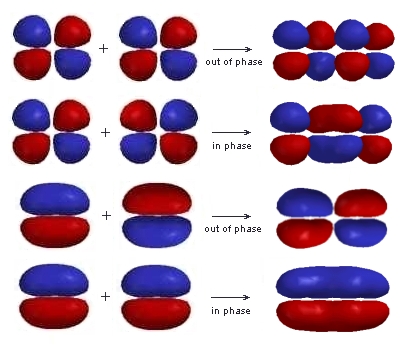
My last attempt was to go down to the quantum level. Here, we cannot be so certain of the behaviors of quantum sized particles. Also, quantum particles are not subject to the same classical laws of physics. In fact, uncertainty is the very nature of this field as we describe parameters in terms of probabilities. In such a physical body, strange things happen as we no longer consider a trajectory corresponding, but rather probability maps. Take for example this following molecular orbitals:
Notice how there are empty spaces in each orbital. Supposedly these electrons jump across the empty space without ever going through the space. Apparently the probability of ever finding an electron in that space is ZERO. I digress.
Upon thinking about this subject matter, I came to reason maybe it is these very uncertainties that our consciousness takes charge of. It is not that our consciousness violates any law of physics, but rather it acts through them. By dictating where the electrons should be (through an infinite number of possibilities) perhaps our consciousness dictates the physical world through some sort of collective butterfly effects. I am reasoning very thinly here, with not much empirical evidence, but maybe this theory is not as crazy as it seems. After all, Einstein held the belief that "God does not play dice." On a deeper level, maybe he was insinuating a higher power taking charge in orchestrating chance and variability.
http://rxdebt.blogspot.com/
I've been taking an intro to philosophy course, so I admittedly I'm a complete knoob when it comes this stuff. However, we've been learning about Socrates's quest for defining what justice is. For Socrates, the truth was out there but it is something that could not be found. With that said, it is better to know that you do not know rather than to be ignorant that you do not know.
In the Republic, Plato tries to define what justice is and how a just society should operate. However, to me, his society and so called justice system sucks.
Thus, we come to Thrasymachus's argument that:
Justice is nothing more than the advantage of the stronger.
Granted Socrates refutes this definition, Thrasymachus still raises an interesting point. There is no such thing as universal justice, and so we cannot define it.
My question to you guys is, is there such thing as a universal justice that we can define? If so, what is it?
I don't know about anybody else, but I always thought English was just showing you could make complex sentences with "appropriate" words. Essentially, you write about nothing (at most answer a simple question) and make it like a piece of art as much (as a high-schooler is able to do). I always got good grades in high-school english, but coming to college, I saw my grades tank to "average" (which is actually below the inflated B-average we see now in most classes). Why? The truth was revealed to me by an amazing English prof that I have this quarter. Turns out you need to say something in your paper!
According to him, it's like making a case...but something that is non-trivial. So, you state something that is debatable and make as strong a case (using stuff i dunno like structure...) as possible. Apparently, he says that high-schools and colleges stress different things. One is deep-reading of a novel and the other would be simply churning out a paper that sounds ok. Who knew...I now feel more confident about my paper haha...
"If you want people to behave as Christians advocate, you should tell them that God does not exist."
Legend A = Australia
C = Canada
D = Denmark
E = Great Britain
F = France
G = Germany
H = Holland
I = Ireland
J = Japan
L = Switzerland
N = Norway
P = Portugal
R = Austria
S = Spain
T = Italy
U = United States
W = Sweden
Z = New Zealand
Hey guys check out this interesting article: http://humaniststudies.org/enews/index.html?id=219&article=7
The gist of the article is that secular (non-religious) societies have much lower rates of violent crimes and teen pregnancy than religious ones.

Top of the class, in both atheism and good behavior, come the Japanese. Over eighty percent accept evolution and fewer than ten percent are certain that God exists. Despite its size – over a hundred million people – Japan is one of the least crime-prone countries in the world. It also has the lowest rates of teenage pregnancy of any developed nation.
(Teenage pregnancy has less tragic consequences than violence but it is usually unwanted, and it is frequently associated with deprivation among both mothers and children. In general, it is a Bad Thing.)
Next in line are the Norwegians, British, Germans and Dutch. At least sixty percent accept evolution as a fact and fewer than one in three are convinced that there is a deity. There is little teenage pregnancy , although the Brits, with over 40 pregnancies per 1,000 girls a year, do twice as badly as the others. Homicide rates are also low -- around 1-2 victims per 100,000 people a year.
At the other end of the scale comes America. Over 50 percent of Americans believe in God, and only 40 percent accept some form of evolution (many believe it had a helping hand from the Deity). The U.S. has the highest rate of teenage pregnancy and homicide rates are at least five times greater than in Europe and ten times higher than in Japan.
All this information points to a strong correlation between faith and antisocial behavior -- a correlation so strong that there is good reason to suppose that religious belief does more harm than good.
So that's the data. The rest of the article goes on to interpret what this data "means." The article's interpretation is intelligent and well reasoned, but I'd like to offer my own commentary:
Of course, I need to point out that correlation is not causation. It's definitely possible that crime and teenage pregnancy (both of which cause poverty and are caused by poverty) and religious belief are all the result of poverty.
This is certainly true in 3rd world countries which are some of the most religious people. However, I doubt this applies in America's case, the richest country in the world.
Here's my explanation: each of the former British colonies has its "birth defects" that they're sorta "stuck with." Canada has the French. Australia has the prisoners. The US had two things: slavery and religious nuts (in the form of Puritans, Quakers, Shakers, Mormons, Amish et al). That's why, in my opinion, America has been so stubborn in it's faith in religion and creationism while the rest of the developed world has "grown up."
How happy you are may depend on how happy your friends' friends' friends are, even if you don't know them at all.
And a cheery next-door neighbor has more effect on your happiness than your spouse's mood.
So says a new study that followed a large group of people for 20 years - happiness is more contagious than previously thought.
"Your happiness depends not just on your choices and actions, but also on the choices and actions of people you don't even know who are one, two and three degrees removed from you," said Nicholas Christakis, a physician and social scientist at Harvard Medical School and an author of the study, to be published Friday in BMJ, a British journal. "There's kind of an emotional quiet riot that occurs and takes on a life of its own, that people themselves may be unaware of. Emotions have a collective existence - they are not just an individual phenomenon."
Interesting stuff! You can read more here.
The brain is like a computer with cell processor. You got like a 100TB Hard drive.The stuff you learned are the software you installed. Your senses are the input devices screaming at the brain about this and that. The opposite sex is a virus that will always try to infect your system. Anything you do is obsolete since anti-virus/firewall never works, but you should be fine as long as you don't toss your computer out the window.
Well, Christmas is nearly upon us and for me at least, it feels like ole saint Nick has accidentally come a few weeks in advance. But this is the season that is so often dominated by two mentalities: one of giving/receiving and one just of love/caring/compassion.
Love/Care/Compassion:
http://www.telegraph.co.uk/news/worldnews/northamerica/usa/barackobama/2460299/Barack-Obama-does-not-give-birthday-presents-to-children.html
Although this is most likely a political move, albeit a smart one, it might be the type of thing that most of us are forgetting. Obama does not buy his children presents (i think this might really turn his kids against him...and since they're hosting sleepovers, things might turn into a complete revolt...with a throng of little, angry, presentless children). Anyhoo, we are so concentrated on making people happy with a gift that we forget WE are the things that are supposed to make them happy...not the new toaster. So what can we do during this holiday season that shows kindness/compassion and love for another person (parents, friends, siblings) that inspire them beyond the disappointment of not getting a gift? If you have a good idea on this...completely ignore the next paragraph =P.
Giving and Receiving:
Many times the holiday season turns into a splurge of shopping for others and oneself. Even those concentrated on giving are often concentrating on giving gifts! Unfortunately, this is the reality of our world though. So, in order to help a few of us out here who have younger, older, ancient siblings (gosh somebody older than john seo...impossible) I wish to make a list that you often see online but is never good and certainly not Asian-appropriate. How many Asian fathers really want that grill-marinating kit as bad as his neighbor? Anyhoo, my problem is a teenage sister (12) who doesn't seem to want anything that doesn't involve high price-tags and dead animals (i'm not talking about beef). Help please! (not just for my sister...but for the general sister, brother, mother...just seeds for present ideas) I will also help anybody who has a teenage brother :). At that age, they love books....yup books and nightstands to put the books on.
"One word frees us of all the weight and pain of life:
That word is love."
-Sophocles
I think love is a religious concept. I'm not referring to the generic pleasure kind of love, but the selfless, unconditional love. The willingness to sacrifice everything, the complete faith and trust, the utter acceptance and support. .. these concepts are not humanly possible no matter how hard we try. We are born as selfish individuals and selfishness is the opposite of love, not hate.
Many religions teach us how to love. Through pain and suffering, we learn how to love more perfectly.
destroy our society? Nuclear weapon proliferation, AIDS, poverty,
global warming, and the impending fuel crisis are commonly known
threats to society. However, there is a rot in our society that has
gone completely unnoticed. It is aggressively unhealthy, wasteful,
and useless. It is our obsession with sports. It floods the media,
drains our time, and all it does is fuel more devotion to sports.
It's not that sports are inherently unhealthy, but the fact that, as a
nation, we are obsessed. When Rome fell, it collapsed around the
Colosseum.
It is undeniable that our modern society has a sports addiction.
Every major city in America has erected sports stadiums. The
tremendous ticket sales pay the multimillion dollar salaries of the
athletes and coaches. TV networks and cable stations cover the games
live, and news programs review the results and highlights. Newspapers
discuss and comment on the games the next day, and the cycle repeats
itself.
This media bombardment has a visible effect on the American
population, dangerously consuming our emotions and brainpower. Sports
are a central topic for conversations and arguments everywhere in
America. The commentator's words are like the Word of God; the
statistics he mentions are unquestioningly quoted word for word by
anyone debating the topic. Fans (short for fanatics) often know the
whole history of their favorite team, and know countless random
statistics. Can you imagine how much time and money is wasted each
year on the media publicizing sports? Can you imagine how many
problems we could solve if we spent a fraction of that time and money
educating the public on the importance of healthy eating or the
dangers of substance abuse?
It's true that sports have redeeming qualities. They teach
discipline and teamwork, and that results come from sweat and hard
work. But for all the time and money invested into sports, what is
the result? What purpose does it serve? No matter how many times a
sports team grabs the national championship; they'll never grab the
cure for cancer. Regardless of how many millions of dollars spent, or
how many hours they train, they'll never fix the hole in the ozone
layer. America's fixation with sports tragically drains our energy
and talents, and it wastes our potential to really make a difference
in the world.
This is by all means not a suicide note or I am not an emo kid. I should prolly give you some background before I present my questions.
This past weekend, my hallmate from my freshmen year killed himself in a cemetary. He lit himself on fire and took his own life. He was a christian, an athlete, high school valedictorian, and etc.
I didn't know him on a very deep level but I have talked to him before and would often enjoy playing Wii or bothering him while he played a game I've never seen before.
Ok that was a very short summary of the background. Now, I want to ask anyone willing to respond. When do you think it'd be okay to suicide? (like if you were being tortured... is it ok?) Do you believe everyone thinks about taking his/her own life the same amount? (does it differ depending on social status, race, religion, or etc.?) And what your opinion is of suicide? (such as religious views or personal views)
I know this is a very somber topic, but I felt like I needed another's opinion about it. Plus, if anyone wants to just give an opinion without answering a question, I welcome it happily.
Heaven-hi!
Joey wanted us to form a religious discussion (not necessarily a debate) allowing us to share our view points. I guess Kevin went ahead and posted an article concerning the FSM, although Kevin is an atheist, so I wasn't sure how serious he was about FSM...
Before I bring this challenge to you, I would like you to watch this random youtube clip:
I thought this clip really demonstrates how small we could be, and it raises the question of the existence of a god, or whatever else may be out there.
Obviously religion is an important issue amongst us. As far has history has been able to recount for the existence of human beings, religion has also co-existed. This discussion is really here to reach far into all corners of philosophical thought pertaining to religion. For example, how do we validate our religion in our own perspective? To what degree of devoutness do we ascertain? What do we believe happens to others who do not follow our religion? How do we justify our religion as being correct? How valid is the historical background of our religion? Certainly do not limit your post to these questions as I encourage those to touch all base necessary. If time permits in your schedule, I, amongst others (I'm sure) will be willing to read the articles to its entirety, so be certain to be thoroughly extensive with your thoughts.
I presume there will be no swearing, hate messages, bigotry, and etc. Again, I encourage those in discussion to avoid attacks on other religious thoughts in hopes of avoiding heated and circular debates.
So I open this discussion to 6 people in particular, though I encourage as many people as possible to participate:
Kevin Tao to discuss Atheism
Roland Liang to discuss Christianity
Wei Luo to discuss Buddhism and Chinese Traditional Thought
Sujeeth Baradawaji to discuss Hinduism
Jeremy Siegel to discuss Judaism
Ibrahim Mekki to discuss Islam
So...get to it
I heard an interesting thing in Economics a few days ago that when polled, 80-90% of the population think that they're "above average" drivers. Same results for looks. Supposedly, they look around and say hmm, "well i know i'm no brad pitt or sarah pallin"...but I'm pretty decent. Obviously 80% of people can't be above average.
Odd that our confidence levels seem to be so high according to these tests...almost doesn't seem to stick with what we know about people. Now, I think that these two things are hard for people to self-inspect because people rarely get people telling them how "beautiful/ugly" they are. For drivers, bad drivers just say that they're "aggressive" and not unsafe, while the unbearably slow drivers just claim to be "safe". There are also no ways of quantifying either of them (tickets/horn beeps might, but people justify more tickets with time saved on the commute...so not poor skills but a conscious trade).
Instead, what about intelligence? Would people generally say they're above average when they know they're a C or a B student? Would be interesting to have people comment anonymously with a number between 1-10 with how smart they think they are COMPARED TO THE WORLD. I think we have pretty high average, seeing how this is an "intellectual" blog haha...and it'll be interesting to compare that number to what happens in the next post.
Our generation looks up to the few titans that seemingly moved the world with their abilities and contributions to the world.
For technology we have: Bill Gates with Microsoft, Steve Wozniak of Apple, Larry Page and Sergey Brin of Google.
Science: Our very own Leon Lederman, whose discovery of the muon neutrino and bottom quark leaves a mark in every physics textbook, Stephen Hawkings, for achieving so much despite his numerous disabilities.
Politics: Bill Clinton
Sports: Michael Jordan
Mr. Rogers made sure that we knew we were all special, Barney told us we would be loved no matter what, and the teletubbies seemed just to promote tele-tubby custard. You pair that with our parents telling us that each of us can be "anything we want to be", and it seems like you're close to Utopia. WRONG! We have bred a spirit of mediocrity where the phrase becomes "Oh, I can do what Bill Gates did...I insert excuse here"
1.) just don't want to
2.) don't want to work that hard
3.) don't care though.
So here I am to tell you the truth. Take any one of us out the world right now, and the fact is that the world would not care. True there will be one more empty seat in Chem... but all you are is a butterfly...and I'm telling you your effect does not stir tornadoes in Jakarta. In essence, the world does not need you, it does not need me.
Some will say, wait..."if I become a good doctor, will I not save hundreds of lives, which changes the future?" Take a look around princess, there's a room-full of people who are capable of doing the same thing that you are making your highest goals, that you believe will set you above mediocrity. Remove you, and the hospital finds another like you. After all, it's not just your class that churns out pre-meds, but every campus in the thousands of schools across the world. So, I ask you now, have you broken mediocrity?
Instead, think about the teacher who goes in and truly makes a difference in her students. Somebody who inspires them to be a doctor rather than drop out of school. Not everybody has the patience, the ability to communicate, the leadership of becoming a good teacher. I would argue that this person has become something great. Turning back to the pre-meds, not all is lost. Think about the people in our generation who will cure cancer, remove the suffering of those with AIDS, and find the cause of diabetes. Hard-work and sacrifice makes us into these worthwhile servants of society. These are the people society recognizes and needs.
For those who are Christian, He gave us Talents, do not be the servant who simply buries it...or even the one that makes only one Talent for his Master. Each one of us ARE special, now realize your strengths and weaknesses and apply them. The keyword is "servants". Let us not let down the world.
For the many of us who are deciding on a career path, remember that how we end our lives in 50-60 years is just a sum of all of our everyday actions right now. With the goals that many of us have right now, even if we achieve them, if this article finally hits home at the age of 50, we will realize that we have been doing nothing worthwhile with our lives. Consider this: I'm an econ major. My job right now is to study and do the best I can to absorb the knowledge around me. Nothing special about that. There are millions of other econ students doing almost the same thing as me. What sets me apart to do something extraordinary lies in three places.
1.) The skill set to allow me to become a great economist
2.) The right goals with what I'm going to do as a "great economist"
3.) The passion for the work that it entails.
I will never be 6'7" and "be like Mike", nor will I be able to memorize what the parts of the body are and what to do when one hurts. My skill sets allow me to analyze human thoughts about money and react on it. Sure I can choose to be a doctor or basketball player, but there will be thousands with the potential to be better than I am. So instead of becoming the 1001st doctor, I will choose to go into a field where I know few have my potential.
Similarly, I have to have a goal that complements my potential. The person next to me may be studying econ just as hard as I am and have the same skill set. He's like many of us, studying to pass the next test and someday get a random job that will pay well. But, if I'm doing it so that my knowledge may one day benefit an impoverished nation that suffers from bad government economic policy, I'm the only one on the path to extraordinary deeds.
Finally is the passion. If I care nothing for helping people or the workings of the "Leviathan" which is our economic system, then both my goals and my job mean nothing. The work that my goals and occupation entails must be something I truly enjoy, or else I will never make the sacrifices necessary to reach my goal. Instead, it's passions combined with our skill-set that should determine our goals.
After all this downing thought, I would like to remind all of us that each of the Titans are also born into mediocrity. Bill Clinton came from an abusive single-parent home after his father, a salesperson, died in his childhood. His hardwork and motivated heart led him to become the able-leader that America needed for a decade of prosperity, positively influencing billions of people around the world. Most people would have given up in Stephen Hawking's shoes, but he ran the extra mile so that his mind could be a blessing to the world. So once again I'll ask you, can you and will you break out of mediocrity?
Each of us can do it.
http://www.ted.com/index.php/talks/martin_seligman_on_the_state_of_psychology.html
It's a 20 minute talk, but I think it will be time well spent. The talk itself invokes stimulating thinking and forces you to analyze where your life is heading. Which path can we take that combines all three sorts of happiness?
To my devoted readers:
It has been far too long since I last penned an essay dealing with the social troubles of our time. I must apologize for the lack of correspondence. I will endeavor to appease my readers’ massive hunger for intellectually stimulating discourse with a topic close to my heart: that of sexism.
I began contemplating this issue when talking to a dear friend of mine. The double standard inherent in dress codes had caught her attention, and her fiery temperament (truly a thing to fear, if you be a misogynic lout with little or no manners) had immediately erupted. “What the hell? I am sick of the tan lines on my upper body. Guys get it easy. If they want to get rid of their farmer’s tan, they can just walk around without a shirt.” The grim line of her lips informed me that this was a situation that did not agree with her. She immediately expanded on her thoughts. “Also, what’s with the dress codes at schools? Like the schools that have their own uniforms. Guys wear slacks and a white shirt with tie. Girls are given skirts that either go down to the ankles or barely cover the thighs. Who designs these things?”
Well, being the helpful and understanding friend I am, I suggested that my friend show the world that she was a free woman by stripping off her shirt (as well as everything underneath it). She threw me a glare that would have rendered most men impotent. “You,” she stated. “Are a pig.”
Let us examine this issue from a different perspective. Why exactly is it that we forbid full or partial nudity in women but only full nudity in men? What are the social pressures that force us to avoid nudity when our European cousins have much laxer rules on the subject? What exactly is responsible for this disjoint, the simultaneous aversion and attraction to breasts?
Why exactly am I focusing on breasts? Because of all the paradoxical feelings about nudity and female organs, this seems the most problematic. One could say that in polite society we ought not to wave around sexual organs. However, even if we accept this as true, there seems no reason for us to ban bare breasted females. Mammary glands produce milk for our young. They serve no “natural” sexual function, and do not constitute sexual organs.
A biologist with an affinity for relational studies might propose that men find the mammary glands attractive because firm, fairly large breasts suggest that a woman would have no problem feeding a child, thus protecting the well being of our as of yet unborn offspring. A Freudian might imply that our subconscious memories of feeding on our mother’s breast lead us (in an odd twist on the Oedipus complex) to find breasts that imitate our mother’s attractive. A boor might intimate (between slurps of beer) that breasts are “God’s gifts to men’s hands.”
I must disagree with the biologist on several points. Firstly, the image of what is “attractive” varies from generation to generation. There was a time when people thought a full set of curves was the way to go. If I was to judge women based on the “Barbie complex” as set forth by popular television today, however, I might be aroused by women who were so skinny as to be almost skeletal, despite the fact that my unborn offspring would never flourish in the womb of a woman who eats nothing but salad. Secondly, though there might be an attraction to mammary glands, there is no reason that this attraction be sexual. Why can’t we love women with healthy mammary glands platonically? We, as humans, find certain aspects of a person to be “attractive” without being sexual. “Healthy mammary glands” would fit nicely with “nice smile” and “firm handshake.” Though a female may want to have sex with a man who has a “nice smile,” she does not have to see the “nice smile” as sexually arousing.
Freudians have always provoked feelings of disgust in me. Perhaps it is their obsession with sex, or their greasy hair and fat lips. Maybe it is those hands, always sweaty—but I digress. The claim that we find breasts attractive because we sucked on our mother’s breasts when we were a child is utter nonsense. It disregards all sorts of background influences. If a child was to find an issue of Playboy underneath his father’s bed, who knows what he might grow up to desire in a woman. Or maybe a baby was not breast fed. Does that baby grow up to be utterly insensitive to the social pressures that dictate “sexual normality?”
As for the boor, I cannot say that I disagree with his statement. I do, however, disagree with the sentiment. I have always found it odd that even as we anthropomorphize objects like our sexual organs and hair dryers, we continue to objectify women as objects of sexual pleasure.
To get back to the main point, dress codes also attribute to this objectification. The truth of the matter is that it should not matter whether or not mammary glands induce sexual arousal. If men can walk around bare-chested, it is only fair that women be allowed to as well. I might (and this is purely hypothetical) find a man with well formed pectoral muscles to be sexually attractive; this does not prevent him from jogging without a shirt. The fact that women cannot do the same suggests that we have a problem with our own sexuality, and that women with bodies that stimulate should be ashamed to compound on our sexuality. Nothing could be unhealthier. Women are not creatures of pure carnality, wantonly flaunting their assets, and they are not beings that exist purely to please men: women are sacrosanct, vessels of life, and above all women are human.
A final word of advice: sexual intercourse is exactly what it sounds like. It is intercourse, not a singular action by a lone person. Too often men are inconsiderate lovers (if I can even use that word) plunging for the “goal” like a horse who has forgotten that someone is riding him. Men, I promise you, if you listen to a woman, you will learn things that you never thought possible. Don’t let your sex life be another victim of the objectification of women.
[Many thanks to Etienne in convincing me to post this]
For those of you who are like me and don't watch much TV anymore, there is a FOX gameshow now that has a new twist how contestants can make money and how to get people to spill their darkest secrets on national television (which inevitably draws viewer attention). So the idea is that half a million dollars can easily be achieved since all of the gameshow's questions...are about you! Essentially "The Moment of Truth" hooks possible contestants up to a polygraph before the show and asks them about 50-60 questions that absolutely train wreck their image, marriage and lives...all for the possibility of winning 500k. The candidates with the juiciest secrets are then put in front of national television, their friends and families and asked to repeat the answers again while strapped to a polygraph again. Questions about feelings towards ex's, family members, past deeds are all fair game and your job is to tell the truth...according to the polygraph. It seems like one of the most uncomfortable and stupid things to put yourself through especially if you're not going to go all the way (which nobody has ever gotten to before). The host himself says that:
When Walberg talked to Access Hollywood about it tonight, he made mention of the fact that the contestants know the questions before they get onto the stage, so it’s not like they’re surprised by the questions. But he seemed to have a hard time understanding why Lauren went forward with the questions, saying, “I don’t have any problem of the fairness aspect of it. I have a problem with her judgment of then choosing to do it.” Walberg went on to say, “I know people are going to think I was BS-ing but the truth is, I was begging her to stop.”link
Now, my thing is, after answering questions that have already thrown your image, your family's image and your marriage out the window...why do people stop? Did they plan to go in there for just 100k pricing their worth in the world for that and a few minutes of national shame? I seriously don't understand how people who value any of the aforementioned things can do this show...and for those who don't actually care...how can they not reach 500k? Nobody has gotten past the 100k mark and I just wonder if they just did not realize that it's either money+a lonely but wealthy life or just continue living happily albeit under a false image. If you're dumb enough to sell out your family and pride for money, at least be smart enough not to put it out on sale.
So besides for thinking of how foolish the contestants must be, I was wondering if lie detectors are really that useful. Everybody has heard about the technical things: heart rate, body heat...but the general idea is if you know you're lying and react...it will know. However, imagine this: have two simple questions in your head, one designed for true and one for false.
Ex:
Is your name Joey? (yes)
Are you really the Batman? (no)
Now if somebody asks you a question such as: (real question on show) do you like your mother in law.
Just calm down, and ask yourself the question "Is your name Joey?" of course not out loud...and then with that question in mind, answer out loud. You can even convince yourself that you have answered the last question already. Imagine the show's surprise when every single one of your answers are different from the audition (you're allowed to change as long as lie detector validates it...and this step needed to get on show). Of course this means that during the audition, every question from the most simple of questions must also be answered in this fashion. So now that I know how to beat the game, all i need is somebody to pretend to be my newlywed and let's go chop that money.
I thought that Tim "GnawMit" did a great job writing that reflection. I definitely can't match his way with words and being an econ major...using more words often leads to diminishing returns =P. But the way Tim went about it reminded me a lot about "The Giver", something that most of us read in middle school. That book, too, paints the "condensing" of our past: history, literature, grammer, in a dark light and even pushes it to an extreme, forcing one "Giver" to bear all of the memories of color, heat, and emotions . Most of us, me included, don't bother to learn latin or what happened in countries that are far far away in times long long ago. Obviously when these topics come up in conversation, we tend to feel a little stupid and wonder if we should know these events. Tim called latin "useless" in a light-mannered tone in response to other people's belief that it was a "dead language".
The question is, is learning about our past and languages such as "latin" useless as suggested by popular opinion? Like Tim said, learning our past is important for our society to move forward. If we see Latin/History as our roots, people like Tim are the stem. By understanding how we as a culture developed, we move closer and closer to understanding the amazingly complex system that we call "human interaction". It's just like when you're building a tower of cards and looking to put the next shaky piece onto the already fragile base. As you're putting on the next card, each previous top-layer is a new base, a new beginning. In the case of progress, to find the path of greatest probability of success, one looks for information. This information of how to move from the present to the future is found in the ways in which society has made her moves in the past. Scientists today look to how nature created eyes, ears and hearts millions of years ago so that they can apply the information to mechanical progress. Similarly, the ways of government, culture and hierarchy of Japan were studied by business administrators for more effective ways of using employees. Basically, it is possible to learn from the past...and from our mistakes.
But then what about the rest of us?...Are we the ones that ought to join Tim as stems?
Nonsensical title I know. I just wrote that to get your attention.
Joey invited me a while back but I didn't get around to joining up until now.
I finished the book Fahrenheit 451, by Ray Bradbury, very recently. I like the book very much, though my brother and his girlfriend both say it sucks. If you don't know what the premise of the book is, I'll explain a little bit.
The book is set in mid-to-late 21st century America, where books are banned by the government. Not because America has become oppressive - but because the public no longer wants to read. Taking advantage of the trend, the government reduces all reading into five-, two-, one-minute vignettes that can be watched on TV. Devices that play music called Seashells are plugged into people's ears 24/7 (by their own choice...iPod anyone?). Firemen no longer put fires out - they start them. For example: "Established, 1790, to burn English-influenced books in the Colonies. First Fireman: Benjamin Franklin," part of a brief history of the Firemen of America in the novel. If a tip is called in, firemen storm into a house to search for books, douse the place in kerosene and FOOM the place goes up in flames. In the backdrop of this dystopian (well, I think it’s pretty dystopian) civilization, the threat of nuclear war is ever-present, though even to this the public is mostly apathetic. I only give background, no plot summary 'cause that'll take too long, but I can post one too if you want.
From here on out is purely my own personal exposition.
So what to say about this Dark Age of Fahrenheit 451? Well, for me, I can see where Bradbury got this idea. All science fiction starts with the question "What if...?" Indeed, what if a fireman's job was to start a fire not put it out? However, I think the question is more "What if people became so apathetic they refused to spend time on thought?" The book is not so much about book-burning as apathy of thought.
I read a lot. In terms of fiction, I prefer science/speculative fiction because many of the writers like to put in philosophy and history and other studies of humanities, essentially making the novel or short story into a commentary on the human condition. I love the question "What if...?" Such questions seem quite useless to those of us who are pragmatic and utilitarian and purposeful with their lives. I would like to be all those things, because then my life would have a clear direction - but for now, as a History major with a Classics minor and a possible double major in English, I prefer to keep thinking such useless thoughts. People ask me why I studied Latin - "It's useless," they say, "nobody speaks a dead language," "it's only good for the SAT." Well, I studied Latin because I'm curious as to how Western civilization came about. Where did our laws come from? Our lierature? The economy? The influence of Christianity? Philosophy and intellectualism? Many people argue that our archaic origins have no more relevance in an increasingly globalized, interconnected, and secular world. Well...if you forget where you are coming from, how are you going to know where you are going?
Throughout history, men and women have argued what the best ways are to lead and to learn and to do all kinds of things. The reason the world of Fahrenheit 451 came about is because writers and intellectuals could not agree on one thing. This made people "unhappy".
aAn excerpt from Fahrenheit 451:
"Picture it. Nineteenth-century man with its horses, dogs, carts, slow motion. Then, in the twentieth century, speed up your camera. Books cut shorter. Condensations. Digests, tabloids. Everything boils down to the gag, the snap ending. Classics cut to fit fifteen-minute radio shows, then cut again as a ten- or twelve-line dictionary resume...But many were those whose sole knowledge of Hamlet...was a one-page digest in a book that claimed: now at last you can read all the classics; keep up with your neighbors...School is shortened, discipline relaxed, philosophies, histories, languages dropped, English and spelling gradually gradually neglected, finally almost completely ignored. Life is immediate, the job counts, pleasure lies all about after work. Why learn anything save pressing buttons, pulling switches, fitting nuts and bolts?"
Widespread Greek and Latin instruction in primary and secondary schools stopped in America a while back. Throughout my time in the K-12 system, I never had a single course in proper English grammar and language. I'm just saying.
It's so much easier to turn on an iPod or a laptop than to open a book. I'm definitely not saying that books are the answer to life (well, if you're a Christian, then the Bible would be). I love watching movies and TV. I follow the Cubs avidly as well as fanatically check my fantasy baseball teams. But I find that many people buy books only to never open them again after perusing it at the bookstore. I'm not condemning them. There are plenty of valid reasons not to open that book again, e.g. not enough time, etc. I definitely don't even read that much, compared to someone like Stephen King, who reads on average 70 to 80 books a year. And many people I know definitely think a lot. But I believe that Bradbury has a valid point about apathy of thought in modern day America. An ever increasingly consumer- and convenience-driven culture takes books out of many people's hands. Many of the college-educated people I meet don't see the point in studying the humanities, because it simply isn't practical. But I encourage all people I know to read books, to take the leisure time to digest what was read and wonder and ask questions.
I’ll leave with one more excerpt from Fahrenheit 451.
“Do you know why books such as this are so important? Because they have quality. And what does the word quality mean? To me it means texture. This book has pores. It has features. This book can go under the microscope. You’d find life under the glass, streaming past in infinite profusion. The more pores, the more truthfully recorded details of life per square inch you can get on a sheet of paper, the more ‘literary’ you are. That’s my definition, anyway. Telling detail. Fresh detail. The good writers touch life often. The mediocre ones run a quick hand over her. The bad ones rape her and leave her for the flies.
“So now do you see why books are hated and feared? They show the pores in the face of life. The comfortable people want only wax moon faces, poreless, hairless, expressionless. We are living in at time when flowers are trying to live on flowers, instead of growing on good rain and black loam. Even fireworks, for all their prettiness, come from the chemistry of the earth. Yet somehow we think we can grow, feeding on flowers and fireworks, without completing the cycle back to reality. Do you know the legend of Hercules and Antaeus, the giant wrestler, whose strength was incredible so long as he stood firmly on the earth? But when he was held, rootless, in midair, by Hercules, he perished easily. If there isn’t something in that legend for us today, in this city, in our time, then I am completely insane.”
This was a random reflection. I don't even know if I made sense. But please, feedback is important to me, so feel free to praise or bash this piece.

 Posts
Posts


