Determinism was a progressive belief, approximately during Newton's time, that rationalized the world with respect to the physical world. As classical mechanics was gradually unfolding it was becoming more and more apparent that there were invariable universal laws that governed physical bodies. Thus, based upon a few initial parameters, one could determine the projected motion of a moving body. This seemed to suggest that physical bodies were not orchestrated in any way, but rather determined ever since the beginning of time. If this were true, this also meant that our actions were determined since space-time began.
Determinism brought crisis to the order of society. It meant that we were no longer liable for our actions, and also suggested that our fate has already been determined. For the religious, the saved are already saved and the damned are already damned. For the non-religious personnel, our actions could no longer be accounted for.
This problem prompted Descartes to establish human consciousness outside the physical world such that it would not be subject to the laws of physics and no longer bound by determinism. By establishing consciousness outside the physical world, order would be restored once again and the power to change the course of our actions is back into our rightful hands.
However, what logic did Descartes use to establish consciousness outside the human brain into some transcendent realm? His logic is as follows:
1. One's whole essence is to think - to be conscious. (Famous lines: I think therefore I am.
2. It is not the whole essence of anything physical to think
3. Thus, one who is the conscious being is not physical.
There is a secondary argument to this. In order to accept premise 2, we must defend it as follows:
2a Anything physical has to be characterized by shape, size, and spacial location
2b Thinking is not characterized as such
Though this argument to a degree seems valid, Descartes would not hold this argument if he accepted the conservation of momentum (or energy for that matter). We now know that the conservation of momentum is an undeniable and fundamental law of physics. How could our consciousness, a non-physical entity, influence the course of various neurotransmitters/electrical impulses in our brain such that we have a conscious experience in the physical world? This would mean our conscious mind would have to change the momentum of various particles without conserving it - such is a gross violation of science, thus rendering this argument invalid.
Now here's where it gets interesting (or maybe less so if you hate physics). I thought upon this issue and tried to doctor this argument. Think for a moment that you have two detachable bodies. If they were to spontaneously split and go their separate ways, momentum would be conserved, and consciousness could be attributed to this spontaneity. However, such did not make sense in terms of the conservation of energy. Then I reconciled that the internal energy (heat of the object) could be converted into kinetic energy and thus both laws of conservation would be satisfied. Again, however, this violated the 2nd law of thermodynamics, where spontaneous processes are irreversible.
My last attempt was to go down to the quantum level. Here, we cannot be so certain of the behaviors of quantum sized particles. Also, quantum particles are not subject to the same classical laws of physics. In fact, uncertainty is the very nature of this field as we describe parameters in terms of probabilities. In such a physical body, strange things happen as we no longer consider a trajectory corresponding, but rather probability maps. Take for example this following molecular orbitals:
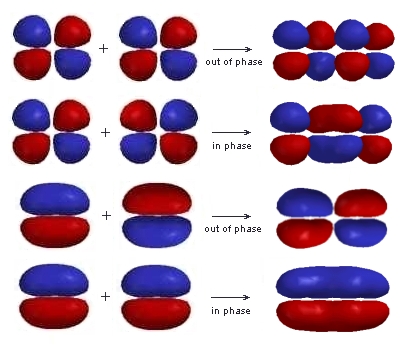
Notice how there are empty spaces in each orbital. Supposedly these electrons jump across the empty space without ever going through the space. Apparently the probability of ever finding an electron in that space is ZERO. I digress.
Upon thinking about this subject matter, I came to reason maybe it is these very uncertainties that our consciousness takes charge of. It is not that our consciousness violates any law of physics, but rather it acts through them. By dictating where the electrons should be (through an infinite number of possibilities) perhaps our consciousness dictates the physical world through some sort of collective butterfly effects. I am reasoning very thinly here, with not much empirical evidence, but maybe this theory is not as crazy as it seems. After all, Einstein held the belief that "God does not play dice." On a deeper level, maybe he was insinuating a higher power taking charge in orchestrating chance and variability.
http://rxdebt.blogspot.com/
Most important advancement in engineering in the next 25 years
So for this scholarship I'm applying for there is an essay question asking that we discuss what we feel will be the most important advancement in engineering in the next 25 years. The essay will be judged on whether they agree, your insight into the subject, and the understanding of the widespread application of ideas.
So, thus far I have compiled a few ideas as to what I think may happen in the next 25 years:
Near room-temperature superconductors
Memristors
Devices making clean water available worldwide
Fusion Reactors
Genetically modified retroviruses as treatment for all sorts of diseases
Ditto for Bacteria
Something making MRIs cheaper (not sure what it would be)
This would be a good topic to start discussing. If any of the other Eng. Students would like to know about the scholarship just speak up and I'll post the link.
Science News: Pain Hurts More If Person Hurting You Means It
Researchers at Harvard University have discovered that our experience of pain depends on whether we think someone caused the pain intentionally. In their study, participants who believed they were getting an electrical shock from another person on purpose, rather than accidentally, rated the very same shock as more painful. Participants seemed to get used to shocks that were delivered unintentionally, but those given on purpose had a fresh sting every time.
Read the full article: Pain Hurts More If Person Hurting You Means It
My comment on this article:
It just goes to show you, pain is all in your head! Actually, almost everything in life is all in your head. I truly believe that if you simply learn to control your emotions, you can achieve anything you want. The thing is, most people psych themselves out, instead of using their self-awareness to their advantage.
New study tracks the transmissibility of happiness
How happy you are may depend on how happy your friends' friends' friends are, even if you don't know them at all.
And a cheery next-door neighbor has more effect on your happiness than your spouse's mood.
So says a new study that followed a large group of people for 20 years - happiness is more contagious than previously thought.
"Your happiness depends not just on your choices and actions, but also on the choices and actions of people you don't even know who are one, two and three degrees removed from you," said Nicholas Christakis, a physician and social scientist at Harvard Medical School and an author of the study, to be published Friday in BMJ, a British journal. "There's kind of an emotional quiet riot that occurs and takes on a life of its own, that people themselves may be unaware of. Emotions have a collective existence - they are not just an individual phenomenon."
Interesting stuff! You can read more here.
Now that the election is over (go Obama!), we expect revolutionary changes perhaps in the near future...
Many believe that in 50 years we will no longer be using laptops, plasma TV, and many other high techs that we are lusting after today. So which direction is technology headed?
Futurama seems reasonable to me. Agree?

 Posts
Posts

