Determinism was a progressive belief, approximately during Newton's time, that rationalized the world with respect to the physical world. As classical mechanics was gradually unfolding it was becoming more and more apparent that there were invariable universal laws that governed physical bodies. Thus, based upon a few initial parameters, one could determine the projected motion of a moving body. This seemed to suggest that physical bodies were not orchestrated in any way, but rather determined ever since the beginning of time. If this were true, this also meant that our actions were determined since space-time began.
Determinism brought crisis to the order of society. It meant that we were no longer liable for our actions, and also suggested that our fate has already been determined. For the religious, the saved are already saved and the damned are already damned. For the non-religious personnel, our actions could no longer be accounted for.
This problem prompted Descartes to establish human consciousness outside the physical world such that it would not be subject to the laws of physics and no longer bound by determinism. By establishing consciousness outside the physical world, order would be restored once again and the power to change the course of our actions is back into our rightful hands.
However, what logic did Descartes use to establish consciousness outside the human brain into some transcendent realm? His logic is as follows:
1. One's whole essence is to think - to be conscious. (Famous lines: I think therefore I am.
2. It is not the whole essence of anything physical to think
3. Thus, one who is the conscious being is not physical.
There is a secondary argument to this. In order to accept premise 2, we must defend it as follows:
2a Anything physical has to be characterized by shape, size, and spacial location
2b Thinking is not characterized as such
Though this argument to a degree seems valid, Descartes would not hold this argument if he accepted the conservation of momentum (or energy for that matter). We now know that the conservation of momentum is an undeniable and fundamental law of physics. How could our consciousness, a non-physical entity, influence the course of various neurotransmitters/electrical impulses in our brain such that we have a conscious experience in the physical world? This would mean our conscious mind would have to change the momentum of various particles without conserving it - such is a gross violation of science, thus rendering this argument invalid.
Now here's where it gets interesting (or maybe less so if you hate physics). I thought upon this issue and tried to doctor this argument. Think for a moment that you have two detachable bodies. If they were to spontaneously split and go their separate ways, momentum would be conserved, and consciousness could be attributed to this spontaneity. However, such did not make sense in terms of the conservation of energy. Then I reconciled that the internal energy (heat of the object) could be converted into kinetic energy and thus both laws of conservation would be satisfied. Again, however, this violated the 2nd law of thermodynamics, where spontaneous processes are irreversible.
My last attempt was to go down to the quantum level. Here, we cannot be so certain of the behaviors of quantum sized particles. Also, quantum particles are not subject to the same classical laws of physics. In fact, uncertainty is the very nature of this field as we describe parameters in terms of probabilities. In such a physical body, strange things happen as we no longer consider a trajectory corresponding, but rather probability maps. Take for example this following molecular orbitals:
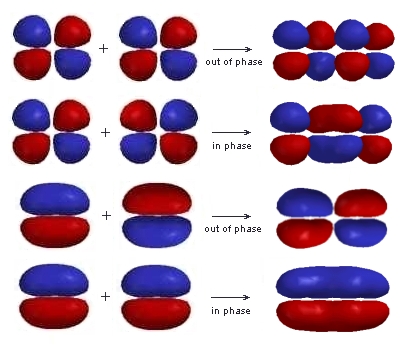
Notice how there are empty spaces in each orbital. Supposedly these electrons jump across the empty space without ever going through the space. Apparently the probability of ever finding an electron in that space is ZERO. I digress.
Upon thinking about this subject matter, I came to reason maybe it is these very uncertainties that our consciousness takes charge of. It is not that our consciousness violates any law of physics, but rather it acts through them. By dictating where the electrons should be (through an infinite number of possibilities) perhaps our consciousness dictates the physical world through some sort of collective butterfly effects. I am reasoning very thinly here, with not much empirical evidence, but maybe this theory is not as crazy as it seems. After all, Einstein held the belief that "God does not play dice." On a deeper level, maybe he was insinuating a higher power taking charge in orchestrating chance and variability.
http://rxdebt.blogspot.com/
I've been taking an intro to philosophy course, so I admittedly I'm a complete knoob when it comes this stuff. However, we've been learning about Socrates's quest for defining what justice is. For Socrates, the truth was out there but it is something that could not be found. With that said, it is better to know that you do not know rather than to be ignorant that you do not know.
In the Republic, Plato tries to define what justice is and how a just society should operate. However, to me, his society and so called justice system sucks.
Thus, we come to Thrasymachus's argument that:
Justice is nothing more than the advantage of the stronger.
Granted Socrates refutes this definition, Thrasymachus still raises an interesting point. There is no such thing as universal justice, and so we cannot define it.
My question to you guys is, is there such thing as a universal justice that we can define? If so, what is it?
It was mentioned in the google discussion that the "islam is" was possibly removed to avoid angering people. Even if that is not the case, we've seen often in current events moments of self censorship on the topic of Islam (for example, the book the Jewel of Medina or the Dutch Muhammod cartoons). What is the significance of this?
"If you want people to behave as Christians advocate, you should tell them that God does not exist."
Legend A = Australia
C = Canada
D = Denmark
E = Great Britain
F = France
G = Germany
H = Holland
I = Ireland
J = Japan
L = Switzerland
N = Norway
P = Portugal
R = Austria
S = Spain
T = Italy
U = United States
W = Sweden
Z = New Zealand
Hey guys check out this interesting article: http://humaniststudies.org/enews/index.html?id=219&article=7
The gist of the article is that secular (non-religious) societies have much lower rates of violent crimes and teen pregnancy than religious ones.
Top of the class, in both atheism and good behavior, come the Japanese. Over eighty percent accept evolution and fewer than ten percent are certain that God exists. Despite its size – over a hundred million people – Japan is one of the least crime-prone countries in the world. It also has the lowest rates of teenage pregnancy of any developed nation.
(Teenage pregnancy has less tragic consequences than violence but it is usually unwanted, and it is frequently associated with deprivation among both mothers and children. In general, it is a Bad Thing.)
Next in line are the Norwegians, British, Germans and Dutch. At least sixty percent accept evolution as a fact and fewer than one in three are convinced that there is a deity. There is little teenage pregnancy , although the Brits, with over 40 pregnancies per 1,000 girls a year, do twice as badly as the others. Homicide rates are also low -- around 1-2 victims per 100,000 people a year.
At the other end of the scale comes America. Over 50 percent of Americans believe in God, and only 40 percent accept some form of evolution (many believe it had a helping hand from the Deity). The U.S. has the highest rate of teenage pregnancy and homicide rates are at least five times greater than in Europe and ten times higher than in Japan.
All this information points to a strong correlation between faith and antisocial behavior -- a correlation so strong that there is good reason to suppose that religious belief does more harm than good.
So that's the data. The rest of the article goes on to interpret what this data "means." The article's interpretation is intelligent and well reasoned, but I'd like to offer my own commentary:
Of course, I need to point out that correlation is not causation. It's definitely possible that crime and teenage pregnancy (both of which cause poverty and are caused by poverty) and religious belief are all the result of poverty.
This is certainly true in 3rd world countries which are some of the most religious people. However, I doubt this applies in America's case, the richest country in the world.
Here's my explanation: each of the former British colonies has its "birth defects" that they're sorta "stuck with." Canada has the French. Australia has the prisoners. The US had two things: slavery and religious nuts (in the form of Puritans, Quakers, Shakers, Mormons, Amish et al). That's why, in my opinion, America has been so stubborn in it's faith in religion and creationism while the rest of the developed world has "grown up."
"One word frees us of all the weight and pain of life:
That word is love."
-Sophocles
I think love is a religious concept. I'm not referring to the generic pleasure kind of love, but the selfless, unconditional love. The willingness to sacrifice everything, the complete faith and trust, the utter acceptance and support. .. these concepts are not humanly possible no matter how hard we try. We are born as selfish individuals and selfishness is the opposite of love, not hate.
Many religions teach us how to love. Through pain and suffering, we learn how to love more perfectly.
Really cool YouTube video!
"Regardless of law, marriage has only one definition, and any government that attempts to change it is my mortal enemy. I will act to destroy that government and bring it down, so it can be replaced with a government that will respect and support marriage, and help me raise my children in a society where they will expect to marry in their turn. Only when the marriage of heterosexuals has the support of the whole society can we have our best hope of raising each new generation to aspire to continue our civilization.."Is gay marriage worth killing people over? If the majority of the people in the country want to impose something over others, should they get it? At one time, the majority of voting Americans wanted slavery, and didn't want women's suffrage. At one time, the majority of Americans wanted Japanese Internment. Is gay marriage an example of history repeating itself? Discuss.
Judaism
Before I start, I want to give a little disclaimer. We have a saying in Judaism that goes: "Two Jews, three opinions". What I mean is, whenever anyone tells you "Judaism believes this", its not usually the only take (of course, you should believe everything I say...). I try to give the Jewish view of itself, mixing in a little objectivity, which you probably won't notice unless you are Jewish. When I use "we" I am referring to Jews, as opposed to people in general. I encourage you to ask any questions you might have, and even to be critical (in the constructive sense, of course). I don't get offended, in general. If you want to email me instead of posting, its seagull5000@gmail.com. A brief outline of my discussion:
- Diety and Belief
- Practice and holidays
- Theodicy and Afterlife
- Who is Jewish and Other religions
- Political issues such as abortion and stem cells.
1. Diety and Belief
Judaism believes in the existence of a single personal God. This God is all powerful and all knowing, and at the same time cares about the individual personally. If the relationship between God and man in Christianity is father and children, in Judaism it is sovereign and subjects. God commands and expects us to obey. God only gives us laws we are able to fulfill, and can therefore can hold us responsible when we break them. Beyond monotheism and the "yoke of the commandments" as it is called, there is little dogma in Judaism in the way of belief. More important, or at least signficant, than belief, is figuring out how god wants us to act. We do that by studying and expounding Gods laws. The most important book in that respect is the Torah. The Torah is like the constitution plus a history book. Traditionally, it is believed God dictated it to Moses around 4000 years ago. It contains the creation story, and the story of how the Jewish people came to be, starting from our forefather Abraham through our enslavement in Egypt for 400 years, which God liberated us from through our leader Moses, to wandering in the desert for 40 years until we reached the land of Israel. It also contains 613 commandments. The rest of the bible (the christian old testament) does not directly contain any commandments. It is the story of the people in the land of Israel up until our dispersion from the land in 70 ce. Afterwards, discussions called the "Oral Torah" on the commandments as well as new laws that were derived from them were collected in the "talmud" in around 400 ce. The talmud contains many debates about the way it is we are to act in different situations and about what the correct laws themselves are. Finally, the laws were officially codified around 1200 ce in the "shulchan orech". From the original 613, 100s or even 1000s more were derived. While many of these laws cannot be found in the torah itself, they are still considered to be the will of god because they are derived from the torah, as we in America might say a law is "constitutional". Judaism is preoccupied with correctly following the laws and thus worshiping god correctly. More on reward and punishment later.
2. Practice and holidays
Some important Jewish practices include prayer, shabbat (sabbath), and kashrut (dietary laws). Other laws deal mainly with a code of ethics (don't kill, don't steal, etc). There are three prayer services everyday, morning, afternoon, and night (or more appropriately, night, morning, and afternoon as the Jewish day starts at nightfall). Prayer can be done individually, but can only fully be done congregationaly (at least 10 people, or traditionally, men).
Kashrut is the system of dietary laws. Jews are only allowed to eat certain animals, and those animals must be killed in the most humane way. Some "unkosher" animals are pig and shellfish. Some Kosher ones are cow and chicken. However, if a cow is not killed in the proper, humane way, it is not kosher. In addition, Jews are forbidden to mix dairy and meat. Many therefore have two sets of dishes for this purpose. Most people wait a certain amount of time between the eating of one and the other (longer between meat and milk than milk and meat).
Shabbat, the sabbath, is every Friday night until Saturday night, and is the most important observance in Judaism, more important than all the holidays, including the "high holidays". (Note an exception- we are obligated to violate the sabbath to save a life). It starts on Friday night at sundown with a traditional meal eaten with family and friends. Through Saturday night, it is forbidden to do all "work". "Work" is a limiting translation of the Hebrew word "malacha". It includes things I do for money, but also other things like cooking, lighting a fire, writing, driving, using electricity, playing music, making plans, use money, etc. The point is to abstain from all things that might keep you from enjoying the day to the fullest as a special day free from normal worries. We take a step back from the world and appreciate the natural order of things, and time with our families. On Shabbat, I like to read, play sports, go outside, play games, and take naps.
There are a number of holidays throughout the year which also require the observances of Shabbat. These celebrate various significant events in Jewish history. Some holidays do not require these observances. In addition, there are a number of fast days throughout the year, all of which (except for yom kippur, the day of attonement) are connected to the destruction of the ancient Jewish temples and our subsequent dispersion and persecution amongst the nations. The high holidays (the new year and yom kippur) occur in fall. (note- the jewish calendar is a mixed solar/lunar calendar, which is why holidays occur at different times relative to the gregorian). On the high holidays, we ask god for forgiveness for the sins of the past year, and pledge to do better this year.
3. Theodicy and Afterlife
Unlike Christianity, there is no definitive concept of an afterlife in Judaism. It is something that is not highly emphasized or explored in Judaism. It is not even mentioned in the Torah. I want to reemphasize as I mentioned above about the relative unimportance of beliefs, that observance of the laws in this life is what is important. Beliefs about an afterlife come as an explanation for why bad things happen to good people (ie that rewards come in the afterlife not this life). Some Jews don't even believe there is an afterlife, that it and reward/punishment were introduced just to give those people who couldn't just obey because god says so a reason to observe. Other conceptions of the afterlife include reincarnation, a nirvana like state, a "world to come", or a revival of the dead in this world. Coming up with explanations for why bad things happen to good people became especially important after Jews lost self rule in 70ce, and were subsequently persecuted nearly everywhere they went for practicing Judaism.
Personally, I believe that whatever happens after this life, it is still better to do "good" things even if there is no reward. The "reward" is being closer to the eternal (god). The reason to do good, even when it may bring us harm, is that we have a partner in god as the one who commands us to do good.
4. Who is Jewish and Other religions.
You are Jewish only if your mother is Jewish or you converted. There are no half Jews. Judaism accepts converts, but not easily. This perhaps rises from the dual character of Judaism as a religion and a nation. It must be something one really wants to do. Judaism does not proselytize. If someone approaches you and asks to convert, you are supposed to turn them away three times. Then, if they persist, you are supposed to ask them "what do you see in this? Don't you know that the Jewish people are exiled, abused and harassed, and that great troubles befall them from time to time?" and if they still want to convert, they are then admitted to a process that takes around two years.
All people are required to observe 7 basic laws (against idolitry, blasphemy, murder, adultery, theft, eating the limbs off animals, and an obligation to set up a just judiciary system).
There was a request to specifically deal with why Judaism does not accept Jesus and Mohamed as prophets, and to explain the Jewish messiah. Note, here I'm not saying that Christianity and Islam are invalid, just why i don't practice them. Prophets in Judaism were really only meant to serve one function: bring the people back to obeying God's laws. A prophet who introduces something new or outside of the original law is not believed to be a Jewish prophet. This comes from the belief that God said everything he had to say in the Torah, and he has no more to say. I think the differences between Christianity, Islam, and Judaism are evident enough to show that these religions were something "new". From my understanding, Judaism is much closer to Islam practically and theologically in terms of submission to the will of God and prayer style amongst other things. Also, the trinity doesn't fit with Jewish theology.
Again, there is no real dogma in Judaism, so the concept of messiah is ambiguous. It isn't mentioned at all in the bible (allow some will say it is indirectly). It was more fully formed after the dispersion in 70 ce. After we were exiled from the land and the temple was destroyed, a major focus of Judaism became mourning these events and hoping that we will one day return. Messiah arose as the belief in someone who would ultimately redeem us from our oppression and bring us back to the land. It is more of a political leader than anything. There are varying views on what exactly this Messiah will do. Some say he'll bring world peace, some say he'll rebuild the temple and reincarnate the dead. Some say he'll only come after we make world peace. According to the most popular tradition, in order to be the Messiah you must be Jewish, male, descendent of Solomon, rebuild the temple, and revive the dead.
5. Political issues such as abortion and stem cells
The views of Judaism get often misassumed here. Abortion is not against Jewish law. Life begins at birth, not conception according to Judaism. Still, Judaism would not have you say "I'm too lazy to put on a condom, you can just get an abortion". But it recognizes that the most important thing is the health of the mother- mental and physical.
Judaism is also for stem cell research, as it can be used to save living people. However, it believes the right way to do this is using embryos that would be discarded anyways as opposed to creating ones just for this purpose.
Please let me know if I have been unclear anywhere, or what needs more explaining. Also, please ask me questions. I don't get offended by anything.
It's interesting that I'm discussing this topic under the religion section, because neither Chinese classical thought nor Buddhism were originally intended to be religious. Either way, what I'm about to talk about should still be relevant to the discussion on religion and belief systems.
------------------------------------------------------------------------------------------------
Here are some unique features of Chinese classical thought:
- The universe is self-creating and self-perpetuating. Because of this, the Chinese originally did not have a creation myth (though many were introduced later).
- Cosmic forces such as ying yang, qi, the 5 agents/elements, and the Dao are in dynamic interaction with each other. Thus, the universe is in constant flux and nothing remains stagnant or permanent. The idea of "to be" (that something just exists) so prominent in Western thought was not a part of classical Chinese thought.
As I see it, these cosmic forces were not exactly religious in nature, rather, they were means by which ancient people could explain the world around them.
- Everything works in correlation. The way that something is comes from the way it relates to everyting else, not from its inherent properties. Therefore, the whole is emphasised over the parts and, in society, the group over the individual.
- No mutual exclusivity. The existence of duality without dichotomy. It is possible to have two mutually defining entities A and B, such that A is A because it is not B, but A can also become B because they are ultimately both part of one big harmonious whole.
The same applies to belief systems; one could potentially be a Confucian in the morning, a Buddhist in the afternoon, and a Daoist at night.
---------------------------------------------------------------------------------------------
With this as the fundamental structure of Chinese thinking, later schools of thought (mainly Confucianism, Daoism, and Buddhism) emerged and integrated themselves in the basic framework to create what we would now call today "Chinese thought."
Daoism
- claims that what's on the surface does not reflect reality, mistrusts words because they cannot fully articulate the Dao
- advocates non-action (wu wei) as the means of aligning oneself with the way of the Dao (which is the ultimate goal of human beings)
- Focused more on individual spiritual living and returning to nature than the other schools.
Confucianism
- The goal of humans is to become moral beings through education, which begins in the family with filial piety. A person must learn his/her proper place in society and act accordingly. Eventually, the things that one wants to do ought to be the same as the things that one should do.
- As you can see, this really isn't a religion, but rather an ethical code governing social relationships and individual life. The only reason why it's an "ism" arises from later historical developments.
Buddhism
- Life is full of suffering. When you die, it doesn't get any better because you are reborn and just begin the cycle of suffering over and over again.
- Desire is the root of all suffering. Buddhists have ascetic practices to control and ultimately eliminate desire. With enough training, one eventually reaches enlightenment and will no longer suffer the cycle of rebirth.
- When Buddhism was introduced to China, it became "popularized" so as to reach a broader audience. An afterlife was introduced, as well as Bodhisattvas (people who have reached enlightenment but choose to remain behind to save everyone else on earth).
Thus, Buddhism, originally more of a philosophy than a religion, became more of a religion than a philosophy.
Due to poor documentation and the abstract nature of the religion itself, there are several interpretations (and misinterpretations) of this religion. The core idea, like in all religions, is to somehow relate the self to the divine. Hinduism tries to offer different paths to this goal (every individual can pick the path that's right for him/her) and argues that they are essentially equivalent.
There are three so-called "major paths" classified by the nature of the human. Jnana Yoga (Path of Knowledge) is suitable for Sattvic people ("Pure" people, usually Brahmanas (Priests) - more on the caste system in a later article), Karma Yoga (Path of Action) for Rajasic people ("Dim" people, usually the Kshatriyas (Warriors) and Vaishyas (Merchants)), and Bhakti Yoga (Path of Devotion) for Tamasic ("Dark" people).
So to sum it up, the goal of human life is salvation (called Nirvana = release from the cycle of reincarnation), which can be achieved through Knowledge, Action, and Devotion.
Speaking of different religious belief, it has become a rationale for terrorism, a way of justifying what is "right" and "wrong".
In the past 200 years, we have gone through 4 waves of terrorism and modelski. we started out with terrorism due to anarchists from 1880-1914, then moved on to nationalist and ideologists from 1920-1960 and 1960-1990 respectively. Finally, religious terrorism initiated after the 1990 and has become a transnational and comic one. The state is no longer the political arbiter, which in turn leads to larger and more violent acts of terrorism.
I can't say what's Al-Qaeda's ultimate motive, but his ideology is justified by his religious belief. He opposes all nations not governed to a particular interpretation of Islam and the US forces in the Middle East, therefore he "attack the enemies of God" in order to create a unified Muslim-state.
Though he might've used religion only as an excuse, but it's sure powerful enough to bring his people together and follow his lead.
So does religion advocate peace or war?
Heaven-hi!
Joey wanted us to form a religious discussion (not necessarily a debate) allowing us to share our view points. I guess Kevin went ahead and posted an article concerning the FSM, although Kevin is an atheist, so I wasn't sure how serious he was about FSM...
Before I bring this challenge to you, I would like you to watch this random youtube clip:
I thought this clip really demonstrates how small we could be, and it raises the question of the existence of a god, or whatever else may be out there.
Obviously religion is an important issue amongst us. As far has history has been able to recount for the existence of human beings, religion has also co-existed. This discussion is really here to reach far into all corners of philosophical thought pertaining to religion. For example, how do we validate our religion in our own perspective? To what degree of devoutness do we ascertain? What do we believe happens to others who do not follow our religion? How do we justify our religion as being correct? How valid is the historical background of our religion? Certainly do not limit your post to these questions as I encourage those to touch all base necessary. If time permits in your schedule, I, amongst others (I'm sure) will be willing to read the articles to its entirety, so be certain to be thoroughly extensive with your thoughts.
I presume there will be no swearing, hate messages, bigotry, and etc. Again, I encourage those in discussion to avoid attacks on other religious thoughts in hopes of avoiding heated and circular debates.
So I open this discussion to 6 people in particular, though I encourage as many people as possible to participate:
Kevin Tao to discuss Atheism
Roland Liang to discuss Christianity
Wei Luo to discuss Buddhism and Chinese Traditional Thought
Sujeeth Baradawaji to discuss Hinduism
Jeremy Siegel to discuss Judaism
Ibrahim Mekki to discuss Islam
So...get to it
Joey asked me to write a little about my religious beliefs, and so I've decided that I will write about that.


A powerful song for you to enjoy.
 Hey everybody, many of you know or know of Matt Norton. He was one of 3 great roommates of mine back in highschool and is an extraordinary influence on everybody around him. For most, college is a time where selfishness reigns supreme: some people choose to just have fun and enjoy these college years while others study hard so that they might get themselves a good job in the future. Norton decided instead to take a year off and help those in need in Louisville, Kentucky. Before I share his first update, which can be found on his facebook account, here's some background info.
Louisville, Kentucky is home to over 550,000 people (2003) *thanks ttao for correction*, making it one of the 20 biggest cities in the United States. It's in the north-central area of Kentucky (see map) and is known for it's healthcare and medical sciences. Despite the many businesses in the city, the median household income is just $28,000 compared to the nationwide average of $50,000. This leaves an incredible 17.8% of the families under the poverty line as of 1999. It's here, in a place of the greatest need where Norton is working and living for a year with the homeless. If you would like to help, please go to the bottom of this post.
October 2008
Dear Friends and Family,
I have been here now for three weeks and I love it at Jefferson Street Baptist Center. There are two male members of the Hope team, Kerry, and myself. There is one female member, Lindsey. We work down in the Day Shelter serving the homeless five days a week. Mondays are considered our “Sabbath” which is set aside to relax, rejuvenate, and have some more contemplative time with God. Wednesdays are outreach days where Kerry and I get to be intentional about spending quality time with the residents here. This week we are hosted a coffee and game day in our apartment for any resident that wanted to come. Those are the basics of the week, but every day is unique and exciting because of the good community and conversation we have.
In these few weeks I can already say that this has been a transformative experience. I have met so many wonderful people who are now becoming the faces of the “homeless” for me. During the week, besides spending time in the Day Shelter, we spend time with the Transitional and Permanent housing residents. All residents are formerly homeless, have a mental illness, and have suffered from an alcohol or drug addiction. Kerry and I eat dinner with them nearly every night conversing and deepening our friendships. They are very open about their lives and what they have done, good or bad. One of my friends comes over at least four days a week and he tells me about his past and what he’s been up to. I quickly learned he plays board games so we play Chess and Stratego together. I am so blessed to be living in this community with so many wonderful guys.
God has also blessed me with a fabulous church community. The whole Hope team goes to a church called Sojourn. The congregation is very welcoming and loving. They receive with open arms everyone from a homeless man to a rich city dweller, all age groups, all races, whatever. This body of Christ welcomes all people as Jesus would. We are also blessed to have a teaching Pastor, Daniel, who is very passionate and Christ-centered. It is very obvious during worship that Jesus is the reason we meet every Sunday. The worship atmosphere reminds me of a giant family. It rejuvenates me and helps to keep walking down God’s path. I have already met numerous members and they are willing to help in any way possible. I’ll say it again I have been very blessed.
One thing that I had not expected when I came to serve at Jefferson Street was to be witnessed to by countless men and women in the Day Shelter. Now daily, many will come up to me out of nowhere and let me know about the presence of Christ in their lives. Every day I am humbled more and more by their words and their actions. As I learn from these Christ followers daily, it made me ask myself what does the Bible say about witnessing and testifying to God’s work in my life. I found that in three of the four gospels there is the story of Jesus telling the disciples about witnessing. He says in Matthew 10:18, “On my account you will be brought before governors and kings as witnesses to them and to the Gentiles.” It goes on to say in verses 19 and 20 “ At that time you will be given what to say, for it will not be you speaking, but the Spirit of your Father speaking through you.” From this I realize that as Jesus’ follower I am going to asked to testify for Him and I need to rely on the Holy Spirit to lead me. Jesus’ words and the example shown by these brothers and sisters in Christ encourage me to share the story of God’s steadfast and patient work in my life.
One particular instance of a Day Shelter guest witnessing to me happened to me a few days ago I was in the closet, which is a big room where our guests can store two bags of their personal belongings. I don’t usually work there, so I believe that it was one of those God things where He made sure I was in the right place at the right time in order for Him to teach me and encourage me in my faith. There were very few people coming into the closet and so I was about to close up when there came this middle aged looking man. He came up showed me his ID and I let him get his bag. I asked how he was and his response was more than a common reply.
He said something to the effect of I don’t always feel well with the discomforts of homelessness, but I have joy in the Lord, my provider. He went on to tell me about his life and how God has brought him through difficult times. He told me that for the majority of his life he has been homeless. He then told me that he is 62, only had a third grade education and that God has always been a faithful companion with him. At those comments I was astounded. This man has spent decades on the streets and he is still praising God for every day he has. Everything he said, he said with cheer and peace. He said things haven’t been easy but he has made it through with Jesus, his Savior at the center of his life.
When he got his suitcase out he opened the front pocket and took out a very old battered Bible. He had bookmarks and on the pages there were countless notes he had made. He turned to Isaiah 40:13 which says, “Who has understood the mind of the Lord, or instructed him as counselor?” and then next to it he had a note that said, 1 Corinthians 2:16. He flipped there and read, “For who has the mind of the Lord that he may instruct him? But we have the mind of Christ.” As Christ is our Lord, those who put their faith in Him may little by little gain understanding of God. He said “I can use that understanding and live for Jesus Christ or I can live for myself and follow the devil. When we let the Holy Spirit lead us it is the Lord working through us for the good.” He told me this all in love and with joy. He encouraged me as the Holy Spirit led him. He reminded me to keep focused on Christ, loving people, and showing them mercy and grace. He took what he needed from his bag, was on his way, and I haven’t seen him since.
This is just one of the many experiences that I have had since coming to Jeff St. I thank and praise God for every day I have here. It is a blessing to be here and all of you are blessings to me. I want to thank all of you who have supported me with your prayers, money, and encouragement through letters and phone calls. I truly appreciate it. God is doing wonders here in my teammates and I but it is not without struggles, so again, I thank you for your prayers. Please keep them coming! I love you all and thank God that you are a part of my life.
With Christ’s love,
Matt
Besides for just watching him however, we can help! Matt needs our support to make a greater difference upon the city of Louisville. To make a donation please read the following:
TO DONATE TO HOPE | Send your tax-deductible donation to
Jefferson Street Baptist Center | Attn: HOPE 733 East Jefferson Street l Louisville, KY 40202
Matt Norton Fund ID #: HOPE-0809-MN1 Make sure to include ID in the check’s memo line
Fundraising Goal: $6,600 I Raised to Date: $3,535
Visit the HOPE website at www.hopeforlouisville.com
Visit our online journal at www.hopeblog.wordpress.com
This is a response to the initial question.
Firstly, let me define sanity as the ability to perceive that which is true.
There are (at least) two possibilities in the ordering of the universe:
1. There exists an abstract quality called "truth" to which everything can be compared.
2. There is no quality of "truth" and everything is subjective.
If the first is true, then we may say that sanity is based on how close we are to that abstract quality of "truth." The problem lies in determining what is "true."
The other option is that there is no way to know if you are sane. This makes everyone's individual beliefs more powerful than any declaration of "truth."
Of course, the inability to determine truth makes outcome 1 basically the same as outcome 2. Enter science.
Science is a system that is focused on knowledge, namely that which we may know. If we accept that the method of science may eventually (and when I use eventually, I use it like one uses "limit as t goes to infinity" in calculus) allow us to understand this abstract quality "truth" then we can use science as our measuring stick. Therefore, we can use science to judge the sanity of a person.
However, there is a pitfall in this method of determining sanity. Enter Kansas person. Kansas person says that God is working behind the scenes. Lottery ticket is not chance but divine intervention. Enter science. Science says.....? Science says that religion falls outside its parameters. It cannot judge whether a religion is “true” or not. There is no basis on which it can make this statement. It can say with relative certainty that there is a mechanism that drives tornadoes, or that there is no voice that is detectable on any current device speaking to you, or that the lottery is certainly based on luck. But it cannot disprove a declaration of faith. And if it cannot disprove it, it has no standard on which to judge it.
So however much one does not believe in a deity, one cannot truly cast aspirations on the sanity of those that do without compromising the method with which they do so.
So in conclusion, neither you nor the Kansas people can be shown to be crazy (unless they are really schizophrenic) using the method above. It is, unfortunately, an unsatisfactory answer. :(
Copied from HotLikeaToaster's note:
But I think we're straying from the original point. There's no need to argue over minutiae like the mythology of Santa. A true believer would definitely come up with indestructible counterarguments to all attempts to disprove it. All you have to say is "metaphorical" and "interdimensional." If u wanna know what I'm talking about, Christians, just tell me, "where" is Heaven, and "where" is Hell? Can we ever send astronauts to Heaven? Can we ever dig deep enough to reach Hell?
I understand Joey's comment to imply that something probably caused or created the universe and the formation of galaxies and life. But to then attribute human-like qualities to this mysterious something, such as emotions (anger, love, vengeance, forgiveness), and to claim that it listens to our "thoughts" and "prayers" and makes a decision to either grant or reject our wishes, is a great stretch. It's totally possible that a non-thinking, emotionless force caused the creation of what we see today.
So it seems to me there is a double standard. When a person "sees and hears" ghosts talking to them about why they are haunting a mansion, society labels that individual as "insane" or "seriously needs help." But when a person "is in a dialogue with" the Christian God of the Bible, and He tells them which lottery ticket to buy or reminds them about their spouse's anniversary, no one thinks it's strange or unusual. That person is considered perfectly normal. Why is that? (and please don't say "Obviously, because the Christian God of the Bible exists and ghosts do not exist") Both of these people believe in supernatural hocus-pocus, but one of them is labeled insane and the other is labeled as normal.
-HotlikeaToaster
Dear HotlikeaToaster,
I understand your concern about my being in this world. I am glad that you are searching for me. However, please understand that I wish most for the promotion of love and goodness. Essential to love is human freewill; as the Creator of the world, I could easily send an unexplainable booming voice across the world every so often so that everybody would know of my existence and power. Yet, people would come to me with the sense that they had no choice. It is love that is forced, and therefore not love at all. Similarly, if you found the Holy Gates of Heaven on the planet which man calls Mars, you would have no choice but to believe in me. Therefore, no, you may not send astronauts to heaven and dig to Hell. Now, about the fact that I have human emotions. Don't you think it's odd for you to have something that the thing that created you doesn't have? Are you, Kevin Tao, claiming that something can come from nothing?
Now, about what you call the double standard. There are people around the world that believe in ghosts and spirits, and their ability to do wicked things. Have you seen the Disney motion picture Mulan? Yup, Buddhists believe in ghosts and spirits of their ancestors. In fact, according to the calendar, this is the month where the gate to their world is most wide open. Yet, these people are not believed to be crazy. Where is the difference between the Buddhists and the insane? The difference does not lie in the numbers, a few insane vs. millions of Buddhists, so it's not a game of popularity. Rather, it is because the Buddhists function regularly apart from their belief in ghosts. If a person believed in the same system of spirits and ghosts but could not process the stimuli (ie: sounds, sights and basic logic) then he/she would be classified as crazy. It is this inability to function regularly apart from one's beliefs that classifies a person as crazy. Otherwise it is just a belief, even if it is far-fetched and erroneous.
I hope that this has been an insightful blog post (It's my first one, but being all-powerful and knowledgable, it really isn't that hard).
Sincerely,
The Word of God (using lovejkoff as a typist)
This was originally a facebook note by HotLikeaToaster:
Hey guys, I was just thinking about this, and I wanted to know what you think about the question of what Sanity is.
Hypothetical scenario:
Imagine that you wake up one day, and everyone around you believes in Santa Claus, and the existence of invisible unicorns, UFO's and sees ghosts. And they believe everything the fortune teller tells them about what's in store for Aquarius's next week.
What if you were the last sane person on Earth?
Would that make you the sane one or the insane one? If everyone else saw the flowing beautiful robes of the Emperor's New Clothes (or at least claims they do) and all you see is a naked guy, and you sane or insane? I really do not know the answer to this.
Now let me give you a twist on this hypothetical situation. Let's say you're an atheist. Let's say you're an atheist living in Kansas. Everyone around you can't help but bring up this deity, whenever they talk about anything. They believe that they are speaking to this deity, and the deity speaks to them, too. They know that the deity is Pure Good, and is all powerful. And there's an Evil Deity who corrupts people and buys their souls by selling witchcraft and sorcery. And they say when good things happen, it's because the deity is showing approval. And when bad things happen, it's part of the deity's Plan. And all this would be wonderful, except you don't hear the deity speaking to you. And you don't see the deity's actions in your life. When a tornado comes, your explanation is the convergence of a warm front and cold front, but they attribute the tornado to the deity. When someone wins the lottery, you see probability and chance, whereas they see a divine intervention or a miracle.
Being alone in your views, does that make you sane or insane? If no one backs you up when you talk about something you see, did you actually see it? Or were you just imagining it? What if you were imagining it, but so was everybody else? How could you confirm whether it's actually there?
If I said, "Religion could just be made up stories, and the voices you hear in your head could be from schizophrenia or hallucinations," to a bunch of pious Kansans, does that make me crazy? Or are they the crazy ones?
-HotlikeaToaster
Response from lovejkoff:
wow...umm i stopped reading the responses and responses to responses very early on so sorry if i'm repeating somebody's statements:-Sincerely yours,
insanity does not deal with your agreement with majority of people although when people use that term loosely it seems to imply that. Instead, people should be thought of as computers. The sane ones take the input 2+2 and spit out 4 as they are supposed to. The "insane" ones spit out the color blue.
Now, the difference between this and Kevin's scenario is that math is supposedly a "universal truth", in that it doesn't matter where you are, or if there is a higher power or not...the definition of 4 is the sum of 2 and 2. You can call it "five", but it's still the sum of 2 plus 2.
So, Kevin's scenario is a scenario in which there is no "logical" answer. Both views considering the facts right now are possible. So, therefore, neither side is "insane" as both sides could be right. Defined and explained in this way, it doesn't matter if you're in a community where the inhabitants just escaped from Arkum (batman reference) and believe that 2+2 = blue or at Harvard...you're not insane in either case...which makes sense.
Now, the problem with this is that a person who continues to believe in Santa Clause has also been lumped into this group of Theists. So now one separates the naive from the "sane". Being naive means that you continue in your beliefs regardless of information in your environment to the contrary. Santa Clause does not have a lair in the North Pole...and if he did, relocation might be necessary because of Global Warming. Nobody has ever seen him, nor has he ever brought the faithful person presents. Rather, you see fake santa clauses everywhere and no candy canes on the north pole. This contrary evidence should tell the person that probability says that there is no Santa Clause.
Turning to God, one argues, ok, in order to have life one has to have reproduction and the ability to gather resources come together in an inanimate object that before this perfect combination of low probability comes together, will continuously fall apart. Imagine trying to build the Sear's Tower by throwing the building materials at the ground (from high up of course). You cannot build it from the base because in the biological case, if you don't complete it when you start it, it has no reason to stay together. Both cases are probably (no research) the same probability.
So atheists believe that given enough tries this would happen (and that Big Bang came from nothing). Theists believe that somebody was holding the structure together so it could be built (and that Big Bang came from something...namely someone). Is anybody insane here? No...but somebody might be naive.
Joey =P

 Posts
Posts


